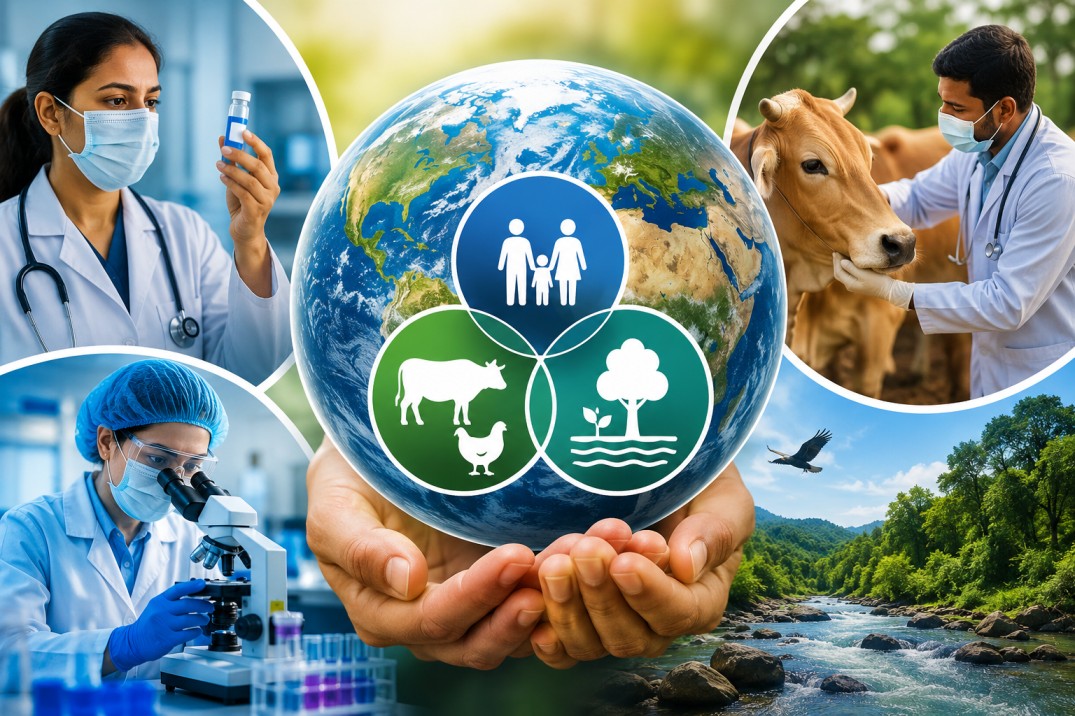
New Delhi: As countries worldwide sharpen their focus on pandemic preparedness and emerging infectious threats, India is intensifying its One Health strategy—an integrated approach that links human, animal and environmental health to detect and respond to disease outbreaks more effectively.
The renewed attention comes amid growing concern over zoonotic diseases, antimicrobial resistance, avian influenza risks and global outbreaks such as Ebola. India’s National One Health Mission, being implemented through the Indian Council of Medical Research (ICMR), is designed to build a coordinated disease-control and pandemic preparedness system by bringing multiple sectors together under a single framework.
The mission aims to improve early warning systems, integrated surveillance, outbreak investigation, research and development, and preparedness for emerging and re-emerging infections. Officials say the initiative is especially relevant for India because of its dense population, large livestock base, rich biodiversity and frequent human-animal-environment interactions that can enable the spread of infectious diseases.
Under the programme, India is working to strengthen laboratory networks, including high-containment facilities, improve data sharing across sectors, and support the development of diagnostics, vaccines and therapeutics for priority pathogens. The One Health framework also seeks to make routine public health systems more resilient by embedding pandemic preparedness into everyday disease surveillance and response mechanisms.
Recent updates to the mission show that the government is moving ahead with governance and surveillance structures. According to official information, the initiative includes collaboration across more than a dozen ministries and departments, while the National Joint Outbreak Response Team has been envisaged to support coordinated action during disease events.
Public health experts say the importance of the One Health model has grown after the COVID-19 pandemic and repeated outbreaks affecting both humans and animals. The approach is also seen as critical in tackling antimicrobial resistance (AMR), which is increasingly recognised as a major health threat. International agencies working with India, including the US CDC, have highlighted the country’s ongoing efforts to expand AMR surveillance, strengthen laboratory systems, improve influenza monitoring and train the public health workforce for faster outbreak detection and control.
The World Health Organization has also been urging countries to reinforce infection prevention and control systems as part of broader health security planning. In recent guidance, WHO has emphasised national action plans, surveillance, and healthcare infection prevention as key pillars for reducing health-system risks from infectious diseases and sepsis-related complications.
India’s health-security push is unfolding at a time when global disease threats remain unpredictable. New outbreaks, the spread of drug-resistant infections and the increasing risk of pathogens crossing from animals to humans have reinforced the need for coordinated public health systems rather than siloed responses.
For India, experts say the success of the One Health approach will depend on how effectively it translates policy into state-level surveillance, rapid diagnostics, local outbreak response, community engagement and seamless data sharing between human, veterinary and environmental health systems.
If implemented robustly, the initiative could become a cornerstone of India’s preparedness strategy—helping the country detect threats earlier, contain outbreaks faster and build a more resilient public health system in an era of complex and interconnected health risks.