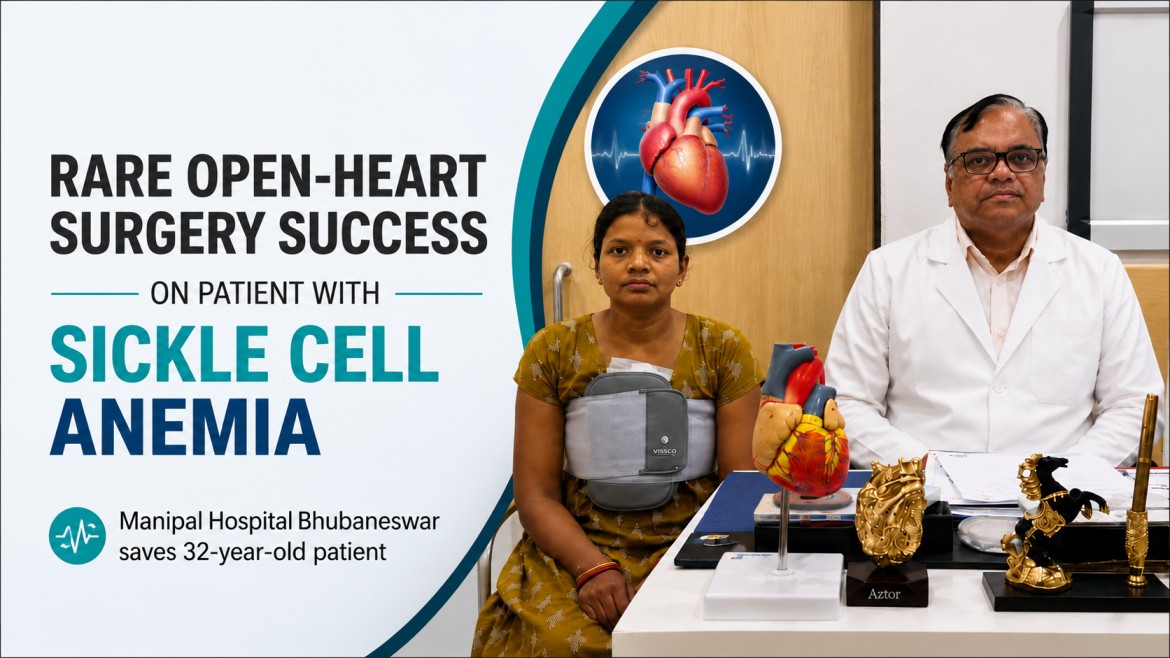
Bhubaneswar: In a rare and medically complex procedure, doctors at Manipal Hospital Bhubaneswar successfully performed an open-heart surgery on a 32-year-old woman suffering from sickle cell anemia, overcoming significant surgical risks to treat two life-threatening heart conditions.
The patient, Ms. Susmita Sethi, had been experiencing severe breathlessness for several years. Her condition gradually worsened, leaving her unable to carry out routine daily activities. She also developed swelling of the face and feet, frequently woke up at night gasping for breath and suffered multiple episodes of unconsciousness, prompting her to seek treatment at the hospital.
A detailed cardiac evaluation revealed that she was born with an atrial septal defect (ASD), commonly known as a hole in the heart, along with severe mitral valve regurgitation, a condition in which the heart valve leaks blood. Both conditions had placed excessive strain on her heart, resulting in symptoms of heart failure. Doctors determined that open-heart surgery was the only viable treatment.
The case became more challenging after doctors discovered that the patient was also suffering from sickle cell anemia, an inherited blood disorder in which red blood cells become crescent-shaped instead of their normal form. These abnormal cells are fragile and can break down rapidly during stress or major surgery, potentially triggering a life-threatening sickle cell crisis. Medical records showed that the patient had previously suffered two such crises and had been treated at Berhampur Medical College, although her underlying heart disease had remained undiagnosed.
The surgery was led by Dr. Jitendra Nath Patnaik, Senior Consultant, Cardiothoracic Vascular Surgery (CTVS), with support from a multidisciplinary team comprising cardiac surgeons, anesthesiologists, perfusionists, transfusion medicine specialists and critical care experts.
Doctors explained that open-heart surgery in patients with sickle cell disease carries exceptionally high risks because it requires the use of a heart-lung machine (cardiopulmonary bypass). During the procedure, blood circulates through artificial tubing and pumps, increasing the likelihood of destruction of sickled red blood cells, severe hemolysis and other potentially fatal complications.
Investigations revealed that nearly 69% of the patient’s circulating red blood cells were sickled, whereas experts consider 25-30% a safer level before undertaking such surgery. To reduce the risk, the medical team performed an exchange transfusion two days before the operation. The procedure, carried out by Dr. Debi Prasad Acharya from the Department of Transfusion Medicine, replaced a substantial portion of the patient’s sickled blood with healthy donor blood, significantly lowering the surgical risk.
Following meticulous pre-operative planning, doctors successfully closed the atrial septal defect using a surgical patch and replaced the damaged mitral valve. The patient recovered well after the operation and continues to remain stable during follow-up. While her cardiac problems have been completely corrected, she has been referred to the hematology department for long-term management of sickle cell anemia to prevent future crises.
Speaking about the case, Dr. Jitendra Nath Patnaik said the coexistence of severe structural heart disease and sickle cell anemia made it one of the most challenging cardiac surgeries undertaken by the team. He credited meticulous planning, pre-operative exchange transfusion and seamless coordination among multiple specialties for the successful outcome.
The hospital said the case highlights the importance of early diagnosis, multidisciplinary collaboration and personalized treatment planning in managing patients with multiple complex medical conditions. It also demonstrates that inherited disorders such as sickle cell anemia need not prevent patients from undergoing life-saving cardiac surgery when supported by advanced perioperative care and specialized expertise.