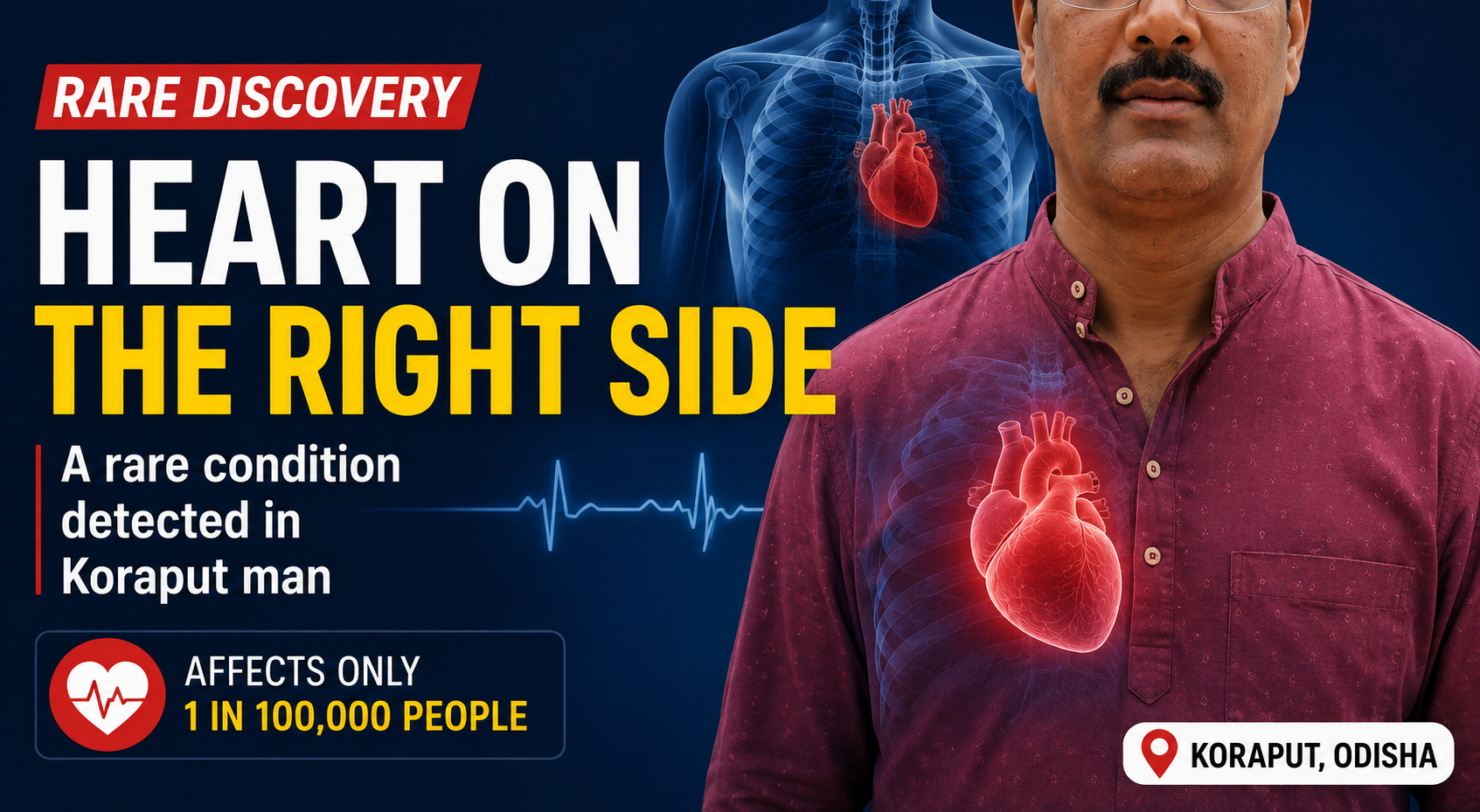
Bhubaneswar: What began as a routine medical evaluation turned into an extraordinary discovery for a 40-year-old man from Odisha’s Koraput district. Doctors found that his heart was located on the right side of his chest instead of the left—a rare congenital condition known as dextrocardia.
The condition came to light during a health check-up in Bhubaneswar. While the man had lived a normal life without knowing about this unusual anatomy, doctors confirmed that he has dextrocardia, a condition estimated to occur in about one in every 10,000 to 12,000 births. (The exact prevalence varies depending on the type of dextrocardia.)
What is Dextrocardia?
Dextrocardia is a rare congenital (present from birth) condition in which the heart points towards the right side of the chest instead of the left. It develops during fetal growth when the heart forms in the opposite direction.
There are different forms of dextrocardia:
- Isolated Dextrocardia: Only the heart is on the right side.
- Dextrocardia with Situs Inversus: The heart and many other internal organs, including the liver, spleen and stomach, are arranged as a mirror image of their usual positions.
- Dextrocardia with Congenital Heart Defects: Some individuals may also have structural abnormalities in the heart, requiring medical treatment or surgery.
Can a Person Live Normally?
Yes. Many people with dextrocardia, especially those without associated heart defects, live completely healthy and normal lives. In fact, some individuals discover the condition only during an X-ray, ECG, CT scan or routine health examination.
However, if dextrocardia is associated with congenital heart disease or disorders affecting the lungs and other organs, symptoms may include:
- Shortness of breath
- Fatigue
- Bluish discoloration of lips or skin
- Frequent respiratory infections
- Irregular heartbeat
Why Early Diagnosis Matters
Although dextrocardia itself may not require treatment, identifying the condition is important because:
- ECG readings can appear abnormal if the condition is unknown.
- Emergency procedures and surgeries require doctors to know the heart’s actual position.
- Some patients may have associated congenital heart abnormalities that need evaluation.
How is it Diagnosed?
Doctors usually diagnose dextrocardia through:
- Chest X-ray
- Electrocardiogram (ECG)
- Echocardiography (Echo)
- CT scan or MRI
Further tests may be advised to determine whether other organs are also reversed or if congenital heart defects are present.
Is Treatment Necessary?
Treatment depends entirely on the underlying condition.
- No associated heart defects: Usually no treatment is required; regular follow-up is sufficient.
- Associated congenital heart disease: Medications or corrective heart surgery may be needed.
- Associated respiratory disorders: Appropriate management is recommended based on the diagnosis.
The Koraput man’s case highlights how some rare congenital conditions can remain unnoticed for decades. While the idea of having a “heart on the right side” may sound alarming, dextrocardia is not necessarily life-threatening. With timely diagnosis and appropriate medical evaluation, many people with this condition enjoy a normal lifespan and quality of life.