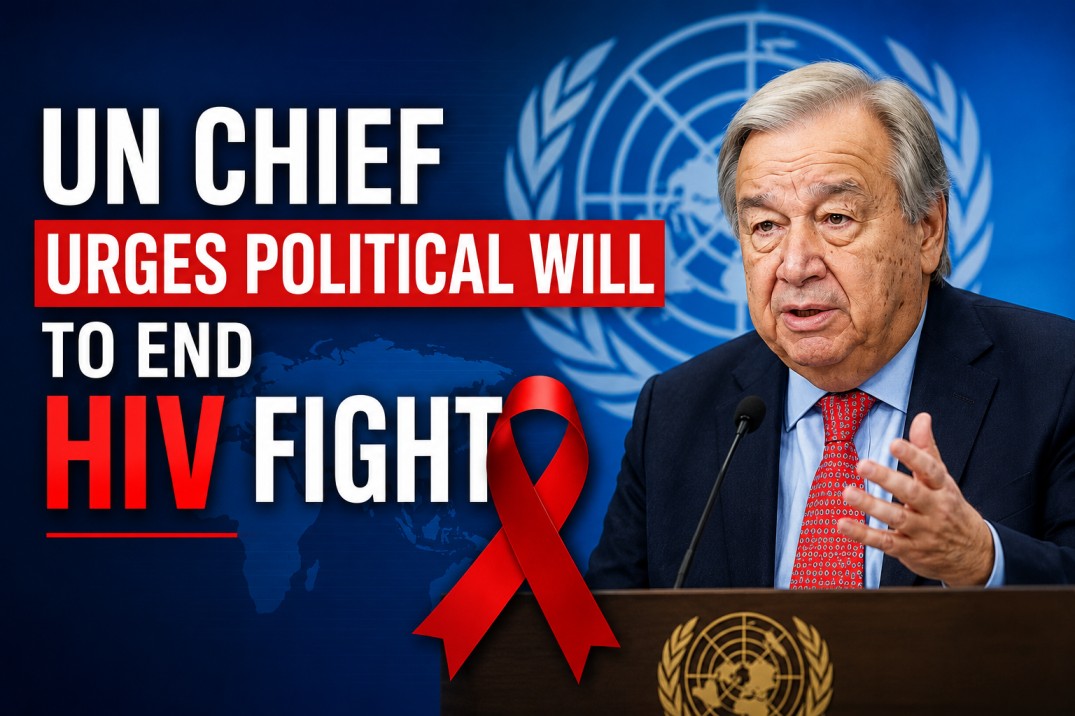
United Nations Secretary-General Antonio Guterres has urged world leaders to show renewed political will and accelerate efforts to end the global HIV/AIDS epidemic, warning that progress made over decades remains fragile and uneven.
Addressing the opening plenary of the UN General Assembly’s High-Level Meeting on HIV/AIDS through Deputy Secretary-General Amina Mohammed, Guterres said the gathering was aimed at “finding solutions” and summoning the political commitment needed to “accelerate and finish the global HIV fight.”
Recalling the global response since the first AIDS case was reported 45 years ago, Guterres said the world had demonstrated “uncommon resolve and solidarity” in confronting the epidemic. He highlighted that AIDS-related deaths have fallen by 70 per cent from their 2004 peak and by 54 per cent since 2010, while HIV prevention and treatment efforts have reduced new infections by 40 per cent since 2010. Today, more than 32 million people living with HIV are receiving life-saving antiretroviral therapy, he noted.
Despite these gains, the UN chief cautioned that “AIDS is not over.” He pointed out that 9.2 million people were still without access to HIV treatment at the end of 2024, underlining the scale of the unfinished task. He also stressed that widening inequalities, shrinking funding, and gaps in access to prevention, treatment and care services threaten to reverse hard-won progress.
To get the global HIV response back on track, Guterres outlined five key acceleration pathways: closing gaps in prevention, treatment and care; ensuring communities remain at the centre of the HIV response; protecting human rights; securing sustainable financing; and reviving the multilateral spirit that has long underpinned the fight against AIDS.
The appeal comes at a time when UNAIDS and other global health leaders have warned of a “perilous moment” for the HIV response, with falling international aid and growing financial pressures threatening services in several countries. The High-Level Meeting is expected to push member states toward a renewed political declaration to guide the global HIV response over the next five years and keep the goal of ending AIDS as a public health threat by 2030 within reach.