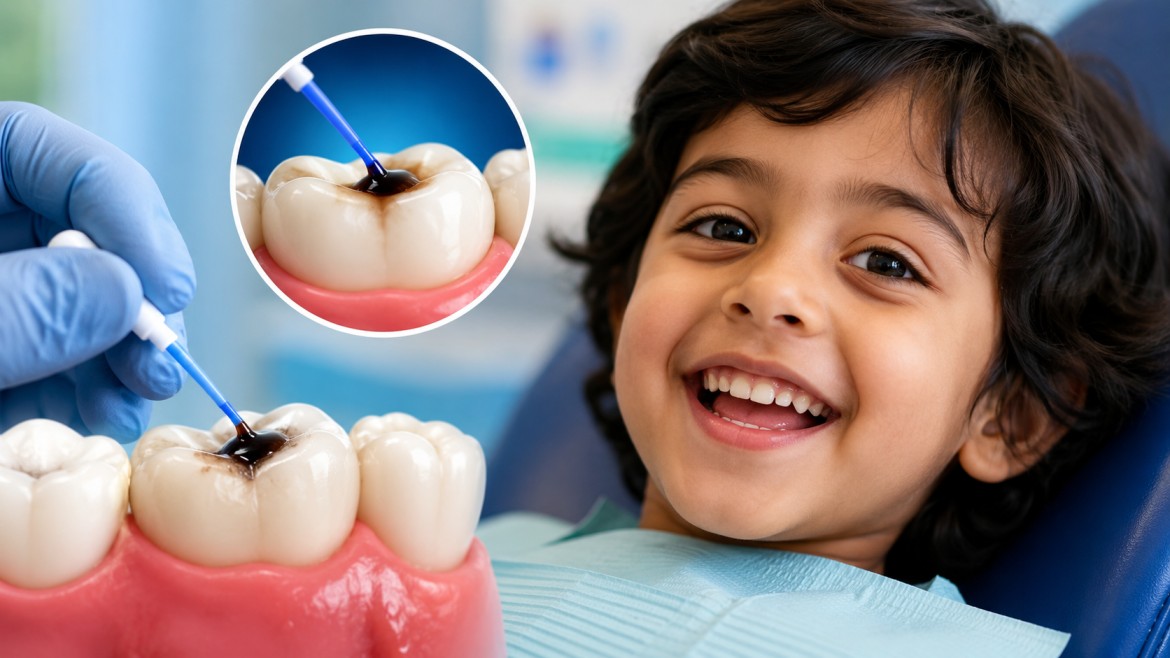
New Delhi: A visit to the dentist may soon become less stressful for children. Researchers in the United States have found that a simple liquid treatment could stop tooth decay without the need for drilling, injections or sedation, offering a less invasive way to manage cavities in young children.
The treatment uses silver diamine fluoride (SDF), a liquid that is applied directly to decayed teeth using a small brush. Unlike conventional dental procedures, it does not require drilling out the damaged tooth or placing a filling. Instead, the solution helps halt the progression of tooth decay by killing cavity-causing bacteria and strengthening the remaining tooth structure with fluoride.
The findings come from a Phase III clinical trial led by researchers at the University of Michigan and published in JAMA Pediatrics. The study involved 830 children under the age of six from Michigan, New York and Iowa. Researchers found that applying 38% silver diamine fluoride every six months successfully stopped the progression of tooth decay in more than half of the affected baby teeth.
According to the researchers, the treatment is safe and effective even for children as young as one year old. They believe it could be especially beneficial for young children who are too anxious, too young or medically unable to undergo traditional dental procedures involving drills or anaesthesia.
Tooth decay remains one of the most common chronic diseases among children worldwide. If left untreated, cavities can cause severe pain, infections, difficulty eating and sleeping, and may eventually require treatment under general anaesthesia. Experts say this simple liquid could help prevent many of these complications by treating cavities before they worsen.
Silver diamine fluoride combines the antibacterial properties of silver with the protective benefits of fluoride. Dentists simply paint the liquid onto the affected tooth, where the silver helps eliminate bacteria while the fluoride strengthens weakened enamel and slows further decay.
However, the treatment does have one noticeable drawback. It permanently turns the decayed portion of the tooth black. While this colour change does not affect the health or function of the tooth, some parents may find it cosmetically unappealing. Dental experts say that for many families, preventing pain and avoiding invasive procedures may outweigh concerns about appearance, particularly since baby teeth eventually fall out naturally.
Researchers also caution that silver diamine fluoride is not a replacement for every dental procedure. Deep cavities, severely damaged teeth and many permanent teeth may still require conventional treatments such as fillings, crowns or root canal therapy. Even so, the study provides strong evidence that the liquid can be an effective option for managing early childhood tooth decay.
Although silver diamine fluoride has been used in several countries for years and has been available in the United States since 2014 for treating tooth sensitivity, experts say the latest clinical trial offers the strongest evidence yet supporting its wider use for cavity treatment. The findings could encourage greater adoption of this simple, painless approach in paediatric dental care, making dental treatment easier and less intimidating for millions of children.